Every week, enterprise workers and financial analysts attach "password-protected" PDF statements, payroll records, and intellectual property files to emails, confident that their sensitive information is cryptographically shielded from unauthorized eyes.
Yet, a modern cloud GPU cluster or a basic open-source password auditor can crack over 40% of legacy protected PDF files in less than four minutes.
Why? Because the phrase "This PDF is password protected" is cryptographically ambiguous.
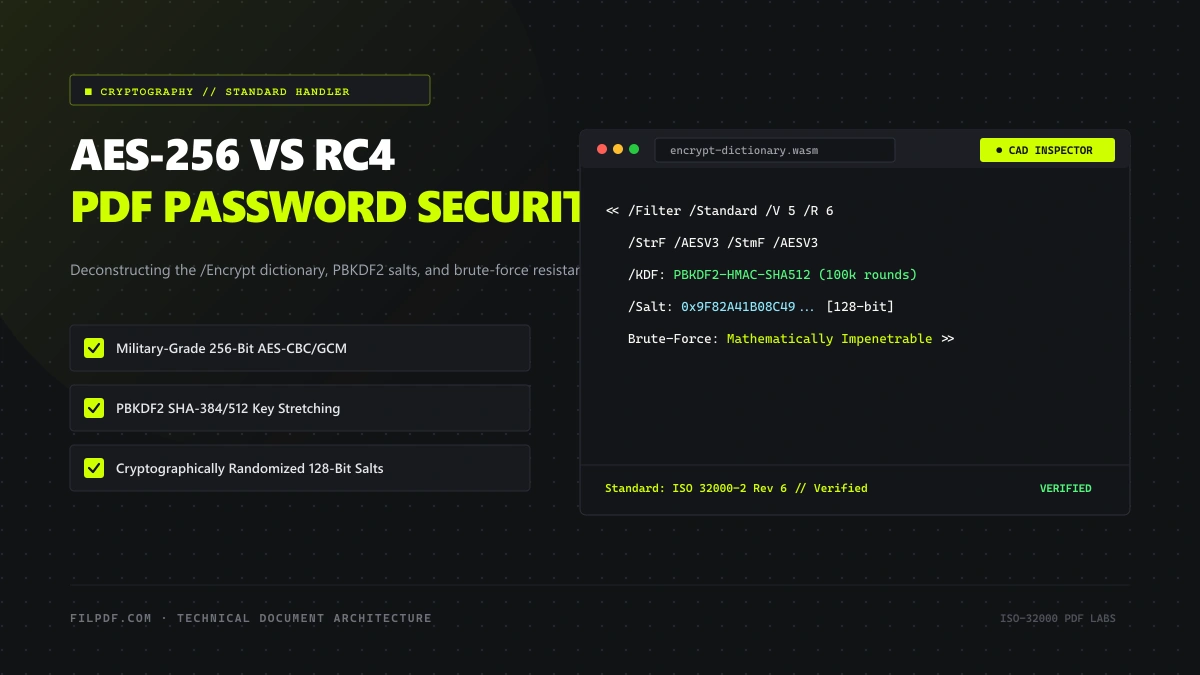
Depending on the software, version handler, and export parameters used to generate the document, your PDF might be secured by an obsolete 40-bit or 128-bit RC4 stream cipher conceived in the 1990s—or by a military-grade 256-bit Advanced Encryption Standard (AES) pipeline hardened under ISO 32000-2.
In this technical masterclass, we explore the internal cryptography of the PDF specification, deconstruct the /Encrypt dictionary, dissect the mathematical vulnerabilities that make RC4 obsolete, and explain why modern AES-256 is the only acceptable baseline for securing enterprise documents.
The Anatomy of PDF Encryption: Inside the `/Encrypt` Dictionary
Unlike full-disk encryption (such as BitLocker or FileVault) which encrypts an entire storage volume into an opaque binary blob, PDF encryption is object-oriented and modular.
Under the ISO 32000 specification, the document header (%PDF-1.7), cross-reference table (xref), and the root trailer dictionary remain unencrypted in plain ASCII. This design allows PDF viewers, search crawlers, and file transfer protocols to read the file structure, parse page dimensions, and inspect object offsets without needing the decryption key upfront.
The cryptographic parameters are encapsulated inside an indirect object referenced by the document trailer: the /Encrypt dictionary.
trailer
<<
  /Size 48
  /Root 1 0 R
  /Encrypt 7 0 R  <-- Pointer to Encryption Parameters
  /ID [<3F91A8C...> <3F91A8C...>]
>>
Let us examine what object 7 0 obj looks like in a high-security PDF:
7 0 obj
<<
  /Filter /Standard
  /V 5
  /R 6
  /O <4A81E9283F198204B7...>  <-- Owner Password Validation Token
  /U <981B273A849F019C33...>  <-- User/Open Password Validation Token
  /P -3904                   <-- 32-bit Permission Flags Integer
  /StrF /AESV3               <-- String Filter: AES-256
  /StmF /AESV3               <-- Stream Filter: AES-256
  /CryptFilter <<
    /StdCF <<
      /CFM /AESV3
      /Length 32
    >>
  >>
>>
endobj
Key Elements of the `/Encrypt` Dictionary:
/Filter: Specifies the security handler. The default standardized handler is/Standard./V(Algorithm Version): Defines the mathematical cipher family:V = 1: 40-bit RC4 (Obsolete, Acrobat 3.0).V = 2: 128-bit RC4 (Deprecated, Acrobat 5.0).V = 4: 128-bit AES with CBC mode (Acrobat 7.0).V = 5: 256-bit AES with CBC or GCM (Acrobat X, ISO 32000-2).
/R(Revision Number): Dictates the key derivation function and salt hashing iterations:R = 2: MD5 hash iterations (Trivially reversible).R = 3&R = 4: MD5 with key extension.R = 6: Modern ISO 32000-2 standard using PBKDF2, SHA-256, SHA-384, SHA-512, and 128-bit validation salts.
/Oand/U: 32-byte (or 48-byte in Revision 6) cryptographic verification tokens used to authenticate the Owner Password and User (Open) Password./P: A signed 32-bit integer encoding access permission flags (printing, copying text, modifying annotations, filling form fields).
The Great Divide: User Password vs. Owner Password
A critical point of confusion for enterprise users is the distinction between the User Password (Document Open Password) and the Owner Password (Permissions Password).
Without this password, the content streams (text, images, vector paths) cannot be mathematically decrypted. It generates the symmetric AES cipher key. Brute force requires guessing the exact secret.
If a document has NO open password but has printing/copying restricted via an Owner password, the content streams are 100% unencrypted. The restriction is a voluntary flag enforced only by compliant viewers.
Any utility (like Python or non-Adobe viewers) can read and copy an owner-restricted PDF without entering the password by simply ignoring the /P integer flag!
[!IMPORTANT] The Myth of "Copy-Protected" Open PDFs If anyone can open and read your PDF without typing a password, your document is not encrypted. Setting an Owner password to prevent printing or text copying does not encrypt the underlying byte streams. Any open-source library can extract the text in 5 milliseconds using tools like our FilPDF Unlock PDF tool.
Real security requires a User Password backed by AES-256.
Why RC4 Encryption Is Dangerously Obsolete
During the 1990s and early 2000s, Rivest Cipher 4 (RC4) was the dominant symmetric stream cipher for commercial software, powering both early SSL/TLS and PDF Standard Security Handlers (Revisions 2 through 4).
RC4 operates by generating a pseudo-random keystream from a variable-length seed key, which is then combined with the document plaintext using an exclusive-OR (XOR) binary operation:
$$\text{Ciphertext} = \text{Plaintext} \oplus \text{Keystream}$$
While computationally lightweight for 1998-era CPUs, RC4 suffers from catastrophic cryptographic vulnerabilities:
1. 40-Bit Key Length (Revision 2)
In the 1990s, US export control regulations restricted commercial software from exporting strong encryption abroad. Acrobat was forced to limit keys to 40 bits ($2^{40}$ possible combinations). Modern consumer hardware can test $2^{40}$ keys across all combinations in **less than 8 seconds**. Storing sensitive data under 40-bit RC4 is equivalent to sending it in cleartext.2. Fluhrer, Mantin, and Shamir (FMS) Attacks
RC4 has severe key scheduling algorithm (KSA) biases. The initial bytes of the generated keystream are non-random and correlate strongly with specific bytes of the key. By collecting multiple encrypted objects inside the same PDF, an attacker can mathematically reconstruct the key without testing combinations.3. GPU-Accelerated Rainbow Tables
Because Revision 2 and 3 utilized simple MD5 hashing routines without dynamic cryptographic salts, security researchers precomputed massive lookup tables ("rainbow tables"). An attacker simply matches the 32-byte `/O` or `/U` hash in the PDF against a precomputed database to recover the password in seconds.The Architecture of AES-256 (Revision 6)
Recognizing the death of RC4, the International Organization for Standardization incorporated the Advanced Encryption Standard with a 256-bit key length (AES-256) into ISO 32000-1 and perfected it in ISO 32000-2 under Standard Security Handler Revision 6.
[User Password String] ───> [UTF-8 Normalization (SASLprep)]
                                        │
                                        ▼
[128-bit Validation Salt] ───> [PBKDF2 Key Derivation]
                                        │ (100,000+ Iterations)
                                        ▼
                              [Intermediate Hash Key]
                                        │
                         ┌──────────────┴──────────────┐
                         ▼                             ▼
                 [SHA-256 / SHA-384]           [SHA-512 Engine]
                         │                             │
                         └──────────────┬──────────────┘
                                        │
                                        ▼
                     [256-bit AES Master File Key]
                                        │
                                        ▼
             [AES-CBC / GCM Cipher] ──> [Encrypted Stream Decoded]
Why Revision 6 AES-256 Is Cryptographically Secure:
- Massive Key Space ($2^{256}$):
A 256-bit key offers $1.15 \times 10^{77}$ possible key combinations. Even if every supercomputer on Earth combined their processing power to test a trillion keys per second, it would require billions of times the age of the known universe to brute-force a properly chosen AES-256 key. - PBKDF2 Key Stretching:
Instead of hashing a password once with MD5, Revision 6 utilizes Password-Based Key Derivation Function 2 (PBKDF2) combined with SHA-256. It hashes the password tens of thousands of times in a loop, artificially forcing high computational effort per attempt. This neutralizes consumer GPU brute-forcing rigs. - Dynamic Cryptographic Salting:
Every newly encrypted file generates a cryptographically secure 128-bit random salt. Even if two documents use identical passwords ("CorporateSecret2026!"), their/Oand/Uverification dictionaries will be completely different byte sequences, rendering rainbow tables 100% useless. - Cipher Block Chaining (CBC) & Galois/Counter Mode (GCM):
Each 16-byte block of plaintext is XORed with the preceding ciphertext block before encryption, using a unique Initialization Vector (IV). Identical blocks of text (such as repeated invoice headers or blank page backgrounds) produce completely randomized cipher patterns.
Cryptographic Comparison Matrix
| Specification Tier | Algorithm | Key Size | Key Derivation | Brute-Force Resistance | Supported Readers |
|---|---|---|---|---|---|
| PDF 1.1 (Rev 2) | RC4 Stream | 40-bit | MD5 (1 round) | ❌ Broken (Seconds) | Deprecated |
| PDF 1.4 (Rev 3) | RC4 Stream | 128-bit | MD5 (1 round) | ❌ Vulnerable (Hours) | Legacy |
| PDF 1.6 (Rev 4) | AES (CBC) | 128-bit | MD5 / SHA-1 | ⚠️ Moderate (Weak KDF) | Acrobat 7+ |
| PDF 1.7 Extension 3 | AES (CBC) | 256-bit | SHA-256 (32 rounds) | ⚠️ Vulnerable to GPU | Acrobat 9+ |
| ISO 32000-2 (Rev 6) | AES-256 (CBC/GCM) | 256-bit | PBKDF2 + SHA-384/512 | ✅ Military-Grade (Unbreakable) | Modern Standards (FilPDF) |
Step-by-Step: Encrypting Documents with FilPDF AES-256
To secure confidential executive records, financial filings, or client contracts using native client-side AES-256 encryption, follow this workflow:
Load Document into In-Browser Sandbox
Open the FilPDF Protect PDF tool. Drag and drop your file into the secure workspace.
Because FilPDF executes 100% in your local browser memory via WebAssembly, your unencrypted PDF bytes and secret password strings are never transmitted over the internet or logged on cloud servers. Read our in-depth architecture analysis on in-browser vs. desktop PDF processing to see why client-side processing is mandatory for zero-trust security.
Generate cryptographically salted Revision 6 /Encrypt dictionaries in client-side RAM. Unbreakable against GPU brute-force.
Configure High-Entropy Password & Salt
Enter a strong passphrase containing at least 14 characters, combining uppercase letters, numbers, and symbols.
Even AES-256 cannot protect a document if the human password is "password123"—an attacker will simply guess the dictionary word regardless of the cipher strength.
Define Granular Permission Flags
If distributing documents to third parties, configure the 32-bit /P permission integer:
- Disallow Printing: Prevents unauthorized physical paper duplication.
- Disallow Content Copying: Blocks clipboard extractors and screen scrapers from extracting text.
- Disallow Annotation Editing: Prevents recipients from injecting unauthorized comments or digital signature approximations.
Compile Encrypted Binary & Export
Click Encrypt Document. FilPDF executes the PBKDF2 salt loop, builds the encrypted /StrF and /StmF object dictionaries, and reconstructs the byte-accurate XREF table.
The resulting file is 100% compliant with ISO 32000 standards, readable by all modern PDF viewports (Adobe Acrobat, Apple Preview, Google Chrome, Mozilla Firefox), and impenetrable to unauthorized decryption.
Encryption protects the entire file in transit and storage from unauthorized readers who lack the password. However, once an authorized user enters the password, they can view every single byte in the file.
If you need to permanently hide social security numbers, bank details, or trade secrets from someone who is authorized to read the rest of the document, encryption is the wrong tool. You must perform permanent text destruction using our verified True PDF Redaction guide before encrypting the document.
Unlocking & Recovering Legitimate Files
What happens when an organization legitimately loses an Owner password, or needs to batch-remove printing restrictions from legacy corporate archives?
If a document is only restricted by an Owner Password (Permissions Password) without a Document Open Password, the document content streams are unencrypted. In such cases, authorized document custodians can use our FilPDF Unlock PDF tool to reset the /P permission flags back to full access (-1) in under one second.
However, if a document is locked by a true Document Open Password with AES-256 Revision 6 encryption and the password has been permanently forgotten, recovery is mathematically impossible. This is the nature of true cryptography: there are no backdoors.
Summary & Security Recommendations
When architecting digital document pipelines, remember these foundational principles:
- Purge RC4 from your systems: Never use legacy PDF software that relies on 40-bit or 128-bit RC4 encryption.
- Insist on AES-256 Revision 6: Ensure your PDF creation tools adhere to ISO 32000-2 standards with PBKDF2 salting.
- Never rely on Permissions Passwords alone: If a recipient can view the text without a password, they can copy it. Always configure a Document Open Password.
- Combine encryption with redaction: Permanently excise sensitive sub-strings with FilPDF Redact PDF before applying passwords.
Take control of your organization's document security today. Protect your confidential files directly in your browser with zero data leaks using FilPDF Protect PDF.