In 2002, an archive team attempting to review digitized architectural blueprints and legal contracts created in the mid-1990s encountered an alarming failure: when opened on modern operating systems, the documents were unreadable. Custom corporate fonts were replaced with garbled question marks, vector line weights were distorted, and color-coded engineering schematics rendered in illegible shades of gray.
The documents were standard Adobe PDFs. Yet, within less than a single decade, they had succumbed to digital document obsolescence.
A standard PDF is designed for immediate presentation and dynamic interaction. It can reference fonts installed on the host operating system, execute embedded JavaScript, link to external web servers, and utilize proprietary encryption algorithms.
When you store a standard PDF for 10, 20, or 50 years, the environment in which it was created ceases to exist:
- The external font licenses expire or change formats.
- The operating system drops legacy color management engines.
- The encryption handlers become incompatible with modern cryptographic libraries.
To solve this systemic risk for courts, national archives, financial institutions, and medical repositories, the International Organization for Standardization created ISO 19005: Electronic document file format for long-term preservation, universally known as PDF/A.
In this architectural guide, we dissect the ISO 19005 standard, compare the critical differences between PDF/A-1b, PDF/A-2b, and PDF/A-3, examine strict technical compliance mandates, and demonstrate how to validate and convert documents for long-term preservation.
The Core Philosophy of PDF/A: Self-Contained and Device-Independent
The foundational rule of ISO 19005 can be stated in one sentence:
A PDF/A file must contain 100% of the information necessary to render identically on any computer system, anywhere on Earth, at any point in the future.
To achieve absolute permanence, the PDF/A specification strictly enforces what may be included—and ruthlessly outlaws anything that depends on external software or dynamic execution:
+-------------------------------------------------------------+
| INCLUDED & MANDATORY IN PDF/A                               |
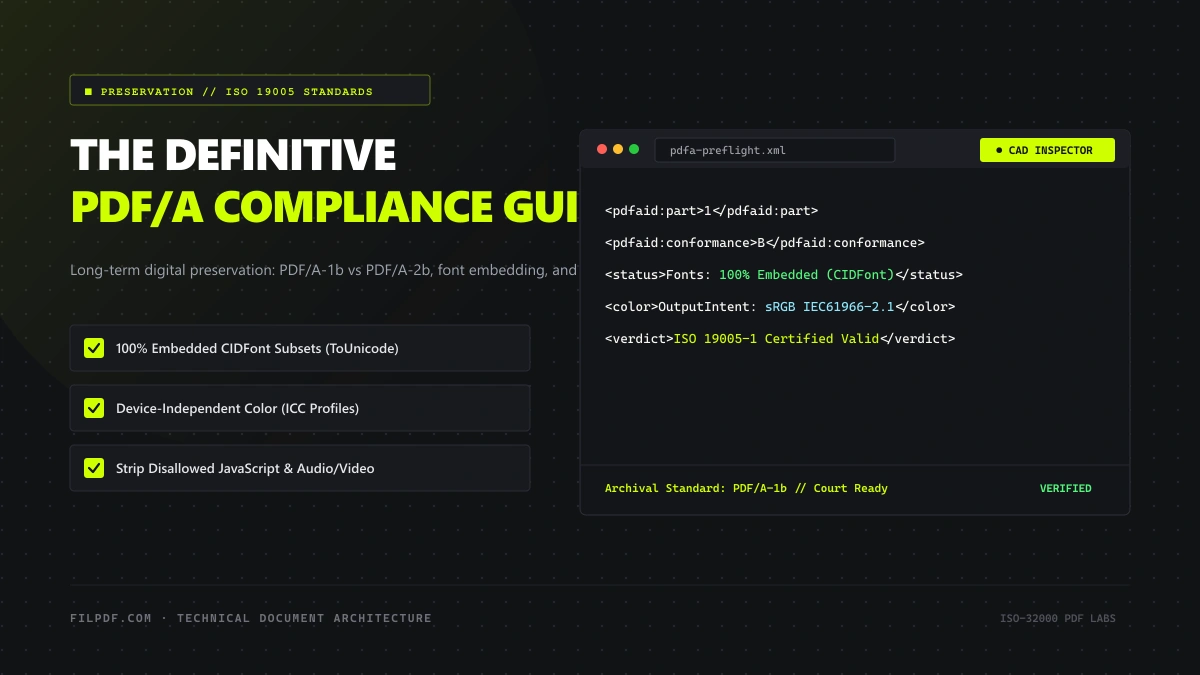
| • 100% Embedded Font Subsets with ToUnicode Mapping         |
| • Device-Independent Color (Embedded ICC Profiles)          |
| • Standardized Extensible Metadata (ISO 16684-1 XMP)        |
+-------------------------------------------------------------+
                              vs.
+-------------------------------------------------------------+
| STRICTLY BANNED & PROHIBITED IN PDF/A                       |
| ✕ Embedded JavaScript or Executable Code                    |
| ✕ Audio, Video, and 3D Interactive Media Streams             |
| ✕ Password Encryption or Cryptographic Locks (/Encrypt)     |
| ✕ References to External Fonts, Images, or Hyperlink Content|
| ✕ Dynamic XML Forms Architecture (XFA) Forms                |
+-------------------------------------------------------------+
If a document relies on a font installed in C:\Windows\Fonts, it cannot be PDF/A compliant. If it asks the viewer to prompt for a password, it cannot be PDF/A compliant. If it contains a script that calculates a date field automatically, it is rejected by archival validators.
The Evolutionary Roadmap of ISO 19005
The PDF/A standard has evolved through multiple parts to accommodate advancements in digital imaging and modern corporate workflows:
[2005: ISO 19005-1 (PDF/A-1)]
  │ ──> Based on PDF 1.4. Baseline preservation. No transparency.
  ▼
[2011: ISO 19005-2 (PDF/A-2)]
  │ ──> Based on PDF 1.7. JPEG2000, alpha transparency, PDF/A embedding.
  ▼
[2012: ISO 19005-3 (PDF/A-3)]
  │ ──> Based on PDF 1.7. Permits embedding arbitrary files (XML, CSV, CAD).
  ▼
[2020: ISO 19005-4 (PDF/A-4)]
  │ ──> Based on PDF 2.0. Modernized modular profiles.
PDF/A Conformance Levels Explained: Level B vs. Level A vs. Level U
Within each ISO standard part, documents are classified by Conformance Levels that determine the depth of preservation:
1. Level B (Basic Conformance — Visual Preservation)
- **Examples**: `PDF/A-1b`, `PDF/A-2b`. - **Objective**: Guarantees that the visual rendering of the document on screen and on physical paper will be 100% identical to the original output. - **Requirements**: Fonts must be embedded; colors must be mapped to ICC profiles; no disallowed dynamic features. - **Enterprise Use**: **95% of all legal and corporate archiving uses Level B**. It is the standard mandated by US Federal Courts (CM/ECF), German tax authorities, and European administrative portals.2. Level A (Accessible Conformance — Structural Preservation)
- **Examples**: `PDF/A-1a`, `PDF/A-2a`. - **Objective**: Guarantees visual reproduction **plus** complete logical document structure for accessibility and assistive screen readers. - **Requirements**: Requires a full hierarchical **Logical Structure Tree** (Tagged PDF) defining headings (``, ``), paragraphs (`
`), table structures (`
`), reading order, and alternative text (`/Alt`) for every raster image.
- **Enterprise Use**: Mandated for government public disclosures, university library dissertations, and compliance with the Americans with Disabilities Act (ADA) / EU Accessibility Act.
3. Level U (Unicode Conformance)- **Examples**: `PDF/A-2u`. - **Objective**: Guarantees visual reproduction (Level B) **plus** exact Unicode character mapping. - **Requirements**: Every embedded font program must include a valid `ToUnicode` CMap dictionary. This ensures that text can be searched, copied, and extracted reliably, even if custom font encodings or specialized scientific symbols were used.Detailed Comparison: PDF/A-1b vs. PDF/A-2b vs. PDF/A-3// STANDARD: ISO 19005-1
PDF/A-1b (The Universal Standard)
Strict, conservative, and universally compatible. Outlaws alpha transparency (drop shadows, opacity layers) and JPEG2000 compression. The default required by most courts worldwide. // STANDARD: ISO 19005-2
PDF/A-2b (Modern Enterprise)
Supports alpha transparency, vector drop shadows, advanced JPEG2000 compression, and enables embedding other PDF/A documents inside a master file (compound document archiving). // STANDARD: ISO 19005-3
PDF/A-3 (Hybrid Invoicing)
Permits embedding non-PDF files inside the archive. Powers international electronic invoicing standards (ZUGFeRD in Germany, Factur-X in France) by embedding structured raw XML data inside a visual PDF. Technical Architectural Mandates of ISO 19005To pass a rigorous PDF/A pre-flight validator, your document must meet three deep architectural standards: 1. 100% Font Embedding and CIDFont SubsettingIn a standard PDF, an application might write a font descriptor dictionary that specifies `/BaseFont /Helvetica-Bold` without embedding the font binary. The operating system uses its local system font or substitutes *Arial*.Under PDF/A:
2. Device-Independent Color & Output IntentsA standard PDF often uses device-dependent RGB (`/DeviceRGB`) or CMYK (`/DeviceCMYK`). These color spaces do not define how a color should look—they merely tell a specific monitor or printer how much ink to spray or voltage to apply. The resulting color shifts dramatically across different screens.Under PDF/A:
3. Destruction of Dynamic XFA FormsAdobe LiveCycle and dynamic XML Forms Architecture (XFA) render forms based on real-time XML data bindings. These forms are completely prohibited in PDF/A because their visual rendering requires proprietary software runtime engines.Dynamic form fields must be converted to static vector drawing paths using a dedicated PDF Flatten tool. Review our technical guide on how to flatten PDF form layers for archiving to understand this requirement. Comparison Matrix: Standard PDF vs. PDF/A
Step-by-Step: Converting & Validating PDF/A with FilPDFTo convert legal exhibits, contracts, financial audits, or medical records into fully certified ISO 19005 archival documents, follow this client-side workflow:
STEP // 01
Load Source Document into Browser MemoryNavigate to the FilPDF PDF to PDF/A tool. Drag and drop your file into the secure workbench. Because FilPDF processes documents entirely inside your browser's local WebAssembly sandbox, your sensitive contracts and corporate financials are never uploaded to remote cloud servers. // ISO 19005 COMPLIANT · ENTERPRISE ARCHIVAL
FilPDF Certified PDF/A Converter
Embed font programs, inject sRGB ICC output intent profiles, strip forbidden scripts, and compile compliant PDF/A-1b/2b archives.
STEP // 02
Select Archival Conformance ProfileChoose your target conformance level based on your regulatory mandate:
STEP // 03
Execute Pre-Flight Normalization PipelineClick Convert to PDF/A. The FilPDF engine executes an automated multi-stage normalization:
STEP // 04
Optional: Convert Monochrome Paper to GrayscaleIf you are archiving high-volume scanned black-and-white contracts, pass the converted file through our Grayscale PDF tool. Stripping unnecessary 24-bit RGB color channels on text documents slashes uncompressed file weights by 66.7%, dramatically reducing cloud storage costs for enterprise archives without impacting compliance. Read our technical breakdown on how to compress PDFs without losing quality for further optimization strategies.
REGULATORY MANDATE // ELECTRONIC COURT FILING (ECF)
United States District Courts and Bankruptcy Courts under the Administrative Office of the U.S. Courts mandate PDF/A compliance for all public filings. Standard PDFs containing un-embedded fonts or JavaScript are automatically rejected by automated CM/ECF intake portals.
Summary & Archival ChecklistDigital formats change, operating systems deprecate legacy software, and computing environments continuously evolve. Creating standard PDFs for records intended to survive decades is a significant operational gamble. Ensure the long-term survival of your organization's institutional knowledge:
Preserve your critical documents for future generations today with zero file uploads and complete privacy using FilPDF PDF to PDF/A. // NATIVE CAD DOCUMENT WORKBENCH100% IN-BROWSER · ZERO SERVER UPLOADS PDF TO PDF/A ISO 19005 Archival Standard FLATTEN PDF Freeze Form & Signature Layers GRAYSCALE PDF Strip 24-bit RGB Overhead COMPRESS PDF Bicubic Stream Optimization VERIFIED BY FILPDF CORE DOCUMENT LABS · ISO-32000 SPECIFICATION COMPLIANT · 100% PRIVACY SANDBOX |